Understanding Multilateral Development Banks
 Jack Seagrist
And the financial pressures they endure

I originally did not know much about the World Bank, and I am by no means an expert now, but I became more familiar with the organization after living in D.C. for a few years. I identified with their mission, which served as motivation to come back to school:
“to reduce poverty, and improve living standards by promoting sustainable growth and investment in people” [1]
This past quarter I took a class on sustainability and resiliency in water resource development. We were required to pick a paper to present to the rest of the class. I was excited that Multilateral Development Banks (MDBs) were one of the available topics as it gave me a chance to dive deeper into the inner workings of the World Bank.
The paper I chose was The Invisible Hand: Financial Pressures and Organisational Convergence in Multilateral Development Banks by Chris Humphrey (2016) [2]. The paper explains how financial pressures have shaped the organizational development of MDBs.
I’ve condensed the information from my presentation on the paper below, enjoy!
Humphrey’s goal of the paper is:
To examine the change in development practices of MDB’s arising from the need to secure financing from capital markets
To understand this it is helpful to know what exactly MDBs are. Investopedia provides a nice definition:
A multilateral development bank (MDB) is an international financial institution chartered by two or more countries for the purpose of encouraging economic development in poorer nations. [3]
There are many of these institutions like the World Bank, the Asian Development Bank, and the African Development Bank.
For my presentation I focused explicitly on the section of the Humphrey’s paper about the World Bank, which happened to be the first MDB. It was founded in 1944 as the International Bank for Reconstruction and Development (IBRD) at the Bretton Woods Conference [4]. It was originally created out of the need for capital in countries rebuilding after WWII. The assumption at the conference was that the World Bank would offer guarantees for governments borrowing from private sources as opposed to providing direct loans. However investors and management at the World Bank disliked this idea and preferred to provide loans. The main problem with lending directly was the shortage of capital raised from member countries compared to the rebuilding effort needed from WWII. $727 million was raised and France and the Netherlands alone needed $1.035 billion.
What happened next?
Out of necessity, they turned to the U.S. capital markets to raise the money. With this shift came recruitment for new leadership and a change in strategy.
The World Bank looked to Wall Street to fill executive-level positions. This led to John J McCloy becoming President, Robert Garner becoming Vice President, and Eugene Black becoming US Executive Director.
With the new team in place, they issued two bonds worth $250 million on July 15, 1947. Their efforts were successful in raising more capital, but they knew they needed to prove their financial credibility if they were to continue this strategy long-term.
New principals were developed as a result. McCloy, with his financial background, knew the importance of making the World Bank appear a sound investment to the investor. This lead to a (1) focus on projects that would generate income and (2) focusing more on borrowing country’s credit risk than issue of need.
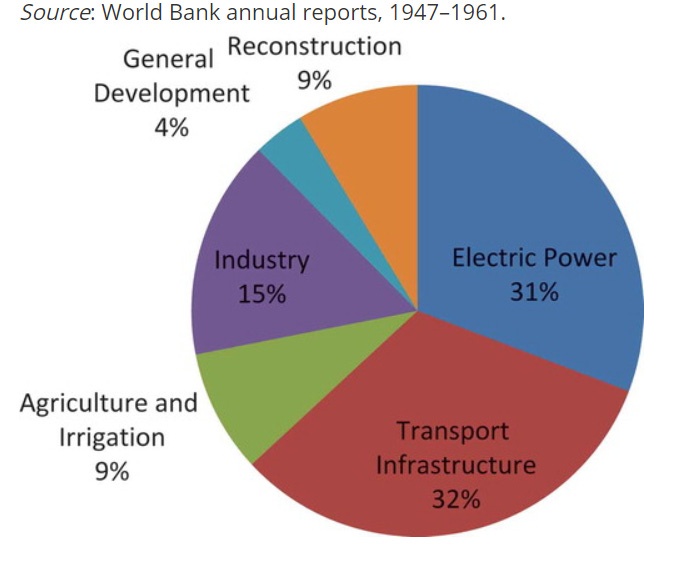
Humphrey provides statistics for the changes this caused during the period of 1947–1961. Of the $5.7 billion provided in loans from the World Bank, 70% went to Europe, Australia, and advanced developing nations while only 30% went to poorer developing nations. The graph below shows a breakdown of spending by project type where it is clear to see financially lucrative projects like electric power were prioritized.
The strategy worked as intended, and in 1959 the World Bank received the coveted AAA ratings which signal the highest level of creditworthiness. With the success in U.S. capital markets, they decided to start accessing markets outside the US. The World Bank’s net income increased from $4 million in 1948 to $288 million in 1964.
Organizations began to take notice and worry about the World Bank straying from their main mission in the 1950's. The Economist claimed they started to more closely resemble commercial banks. Even the United Nations (U.N.) stated they were not meeting their mission, proposing to create an international development authority within the U.N. to solve the problem.
Eventually the US prosed their own solution with the creation of the International Development Agency (IDA). The idea was to house this new organization as a separate arm under the World Bank with separate financial accounts and softer lending practices to answer critics claims of not meeting their original mission. This structure would allow the World Bank to still have involvement and veto power over the IDA’s projects.
After the IDA’s creation, it proved to be a valuable asset to the World Bank’s portfolio. The riskiest loans housed under the World Bank were offloaded to the IDA. In 1963, 27.3% of the World Bank’s loans were considered high risk. By 1975, that number was down to 15%.
It also eased the pressure on the net income of the World Bank. By 1964, their revenue had gotten so large there were fears of the U.S. Congress stepping in to take and reallocate the funds. With the creation of the IDA, the World Bank was able to move funds to this new portfolio that aligned more with the original mission and still have control of the funds.
Humphrey states that when organizations are forced to choose between adhering to their original mission and securing resources to survive, they often choose the latter.
Entry into capital markets for the World Bank was borne out of necessity and lack of government donor funding. This resulted in an organizational culture shift over the years, at times focusing more on credit worthiness over need. It also created a second set of stakeholders, the investors, in addition to the member country governments that the organization needed to satisfy.
With all that said, it remains the best option. It provides MDBs with a sense of autonomy and less influence from shareholder countries as they are raising their own money. From 1945–2013, the World Bank lent $586 billion, only $13.4 billion was from shareholder countries. That is an incredible amount of investment, in addition to the countless hours spent by staff, to make people’s lives across the world better.
Click the link below to see some of the World Bank’s amazing projects!
Jack Seagrist is currently a student at Stanford pursuing an MS in environmental engineering. He is passionate about using the latest data driven processes to solve climate challenges. Reach out via twitter, linkedin, or check out his website to learn more about his work.
Read next: My Journey to Grad School at Stanford
References:
[1] — Stott R. (1999). The World Bank. BMJ (Clinical research ed.), 318(7187), 822–823. https://doi.org/10.1136/bmj.318.7187.822
[2] — Chris Humphrey (2016) The Invisible Hand: Financial Pressures and Organisational Convergence in Multilateral Development Banks, The Journal of Development Studies, 52:1, 92–112, DOI: 10.1080/00220388.2015.1075978
[3] — https://www.investopedia.com/terms/m/multilateral_development_bank.asp
[4] — https://www.worldbank.org/en/about/archives/history/exhibits/bretton-woods-monetary-conference
[5] — https://commons.wikimedia.org/wiki/File:Caen_in_ruins.jpg
